Vancouver, British Columbia – February 26, 2026 – Lion Rock Resources Inc. (TSX-V: ROAR, FSE: KGB, OTCQB: LRRIF) (the “Company”) is pleased to report drill results from the Giant Volney target area at its Volney Project in the historic Black Hills mining district of South Dakota, USA.
Initial results from the Company’s recently completed Phase 1 drill program have returned significant lithium-tin-tantalum results (Table 1) along with anomalous critical mineral results. Approximately 3,600 metres of diamond drilling across 15 drillholes has been completed along the Volney trend (Figure 1). Partial assay results from four drillholes are set out below. The remainder of the assay results on those drillholes as well as full assay results from the other 11 drillholes, including additional lithium and gold analyses, remain pending and will be reported as received.
News Highlights
- Significant Lithium Intercepts at Giant Volney at Surface:
Drillholes VOL25-004, VOL25-005 (Figure 2), and VOL25-007 (Figure 3) returned multiple lithium-bearing pegmatite intersections including:
- 0.8% Li2O over 25.4 m, including 1.3% Li2O over 14.3 m (VOL25-004)
- 1.5% Li2O over 10.3 m, including 2.2% Li2O over 1.3 m (VOL25-005, ended in pegmatite)
- 1.6% Li2O over 10.6 m, including 2.3% Li2O over 5.7 m (VOL25-007)
- Tin and Tantalum Mineralization Confirmed:
Drilling intersected muscovite-rich pegmatite hosting tin and tantalum mineralization, including:
- 72 ppm Ta over 5.7 m within the lithium interval in VOL25-004
- 120 ppm Ta over 3.0 m within VOL25-005
- 0.1% Sn and 45 ppm Ta over 28.3 m, including 0.3% Sn and 120 ppm Ta over 3.0 m (VOL25-006)
- 0.1% Sn and 53 ppm Ta over 6.2 m (VOL25-007)
- Multi-Element Critical Mineral Signature Confirmed in Pegmatite:
Initial assay results confirm lithium–tin–tantalum mineralization within pegmatite. Assays also returned elevated gallium (up to 67 ppm), rubidium (up to 3,948 ppm), cesium (up to 938 ppm), and tantalum (up to 301 ppm). The multi-element enrichment is consistent with a fractionated and evolved LCT pegmatite system and supports interpretation of geochemical zonation within the pegmatite body.
- Collared Directly into Pegmatite; Intersections Represent Partial Thickness Only:
All four drillholes were collared directly into pegmatite. As a result, the reported intervals represent partial intersections and do not reflect the full interpreted width of the pegmatite body, which mapping and sampling indicate extends west of the drill collars. Hole VOL25-005 was terminated early after intersecting historic underground workings and ended in pegmatite.
- Similar Pegmatites Observed More Than 250 m North - Assays Pending:
Additional pegmatite units were intersected more than 250 m north of the Giant Volney area (Figure 4), including near the Rough & Ready target. These pegmatites are mineralogically similar to those observed in drillholes VOL25-004, VOL25-005, VOL25-006, and VOL25-007. Multiple additional pegmatite outcrops exhibiting lithium values have been identified on surface across the property and remain untested by drilling. Assay results for these holes are pending and will be reported as received.
- Six Critical Minerals Identified at Volney:
The Volney Project hosts lithium, tin, tantalum, gallium, cesium, and rubidium all of which are included on the current US Critical Minerals List, underscoring the project’s multi-commodity critical mineral profile.
Dale Ginn, President and CEO of Lion Rock, stated “These results confirm Giant Volney as a well-developed, near-surface LCT pegmatite system enriched in lithium, tin, tantalum, and gallium. The presence of multiple critical metals within a single zoned pegmatite body highlights the broader strategic relevance of Volney as North America continues to prioritize secure domestic supply chains for lithium and other critical minerals. Importantly, these results represent only the first batch of assays from our Phase 1 drill program, with additional lithium and gold results pending from multiple target areas along the Volney trend. We believe this marks the beginning of a broader evaluation of the district-scale potential at Volney.”
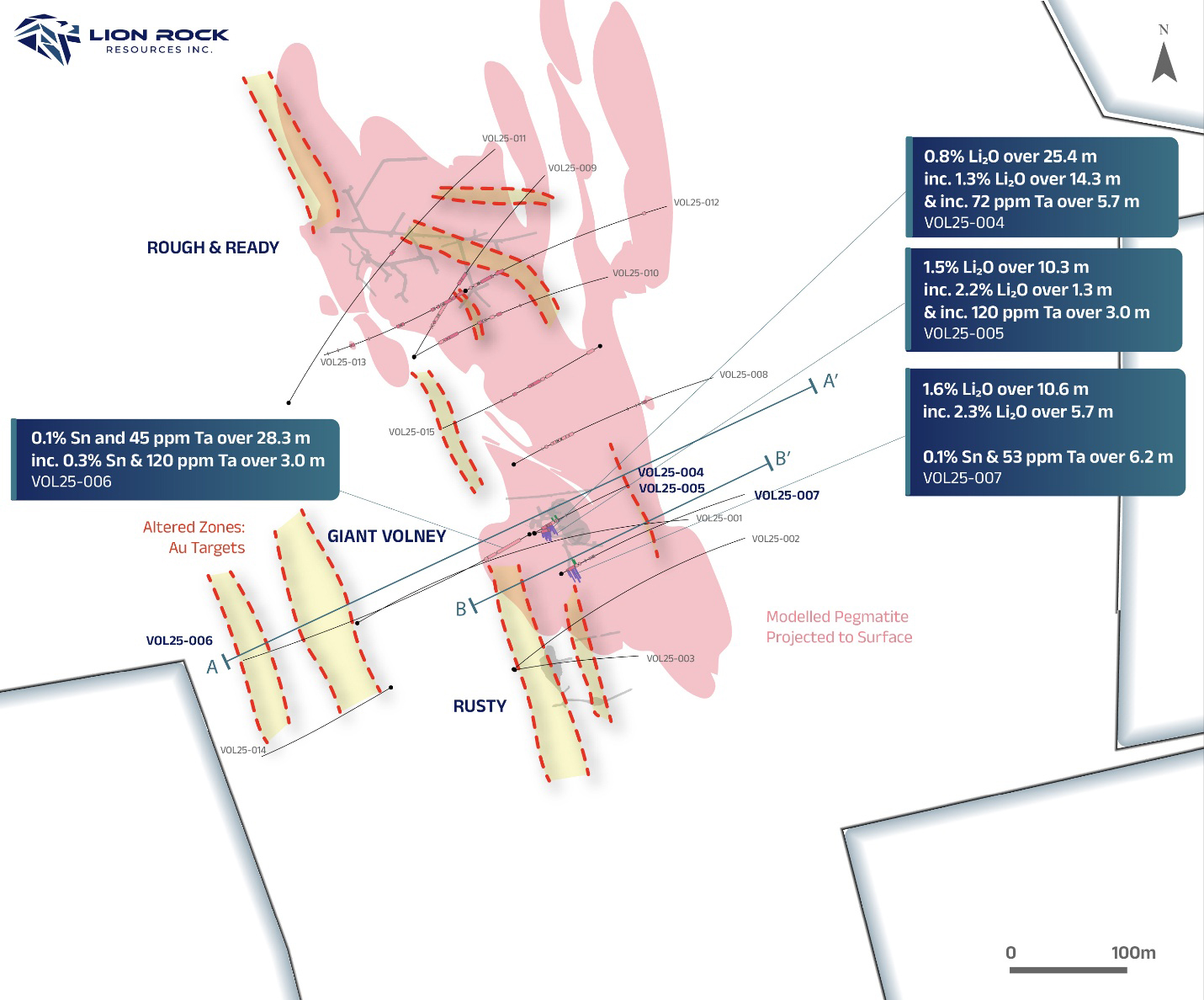
Figure 1. Plan map showing completed drillholes, mapped and modeled pegmatite projected to surface, interpreted gold target zones from observed alteration and sulphide mineralization, and notable assay results from drillholes VOL25-004, VOL25-005, VOL25-006, and VOL25-007.
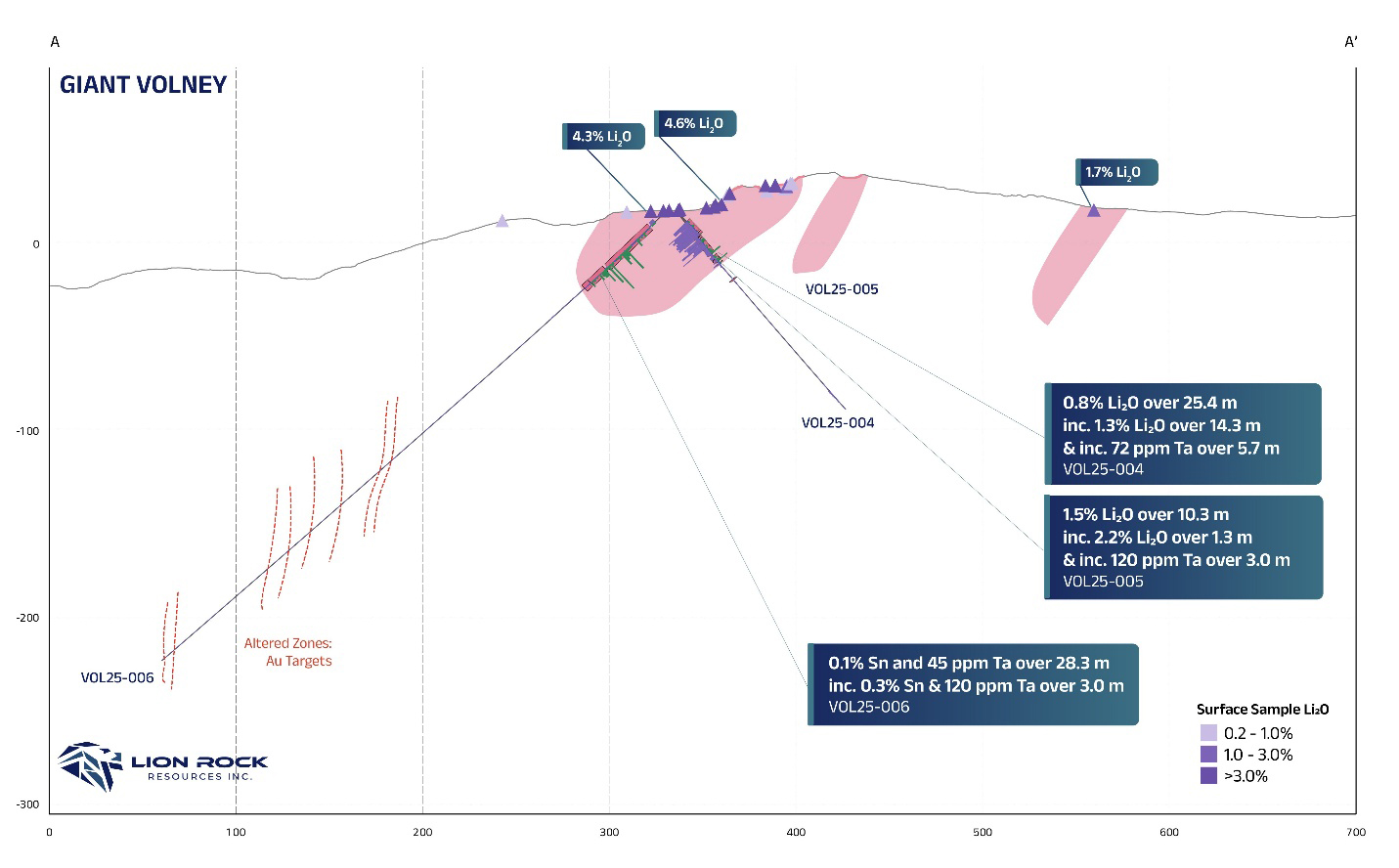
Figure 2. Cross-section looking northwest showing pegmatite intersections and notable lithium, tin, and tantalum intercepts from drillholes VOL25-004, VOL25-005, and VOL25-006.
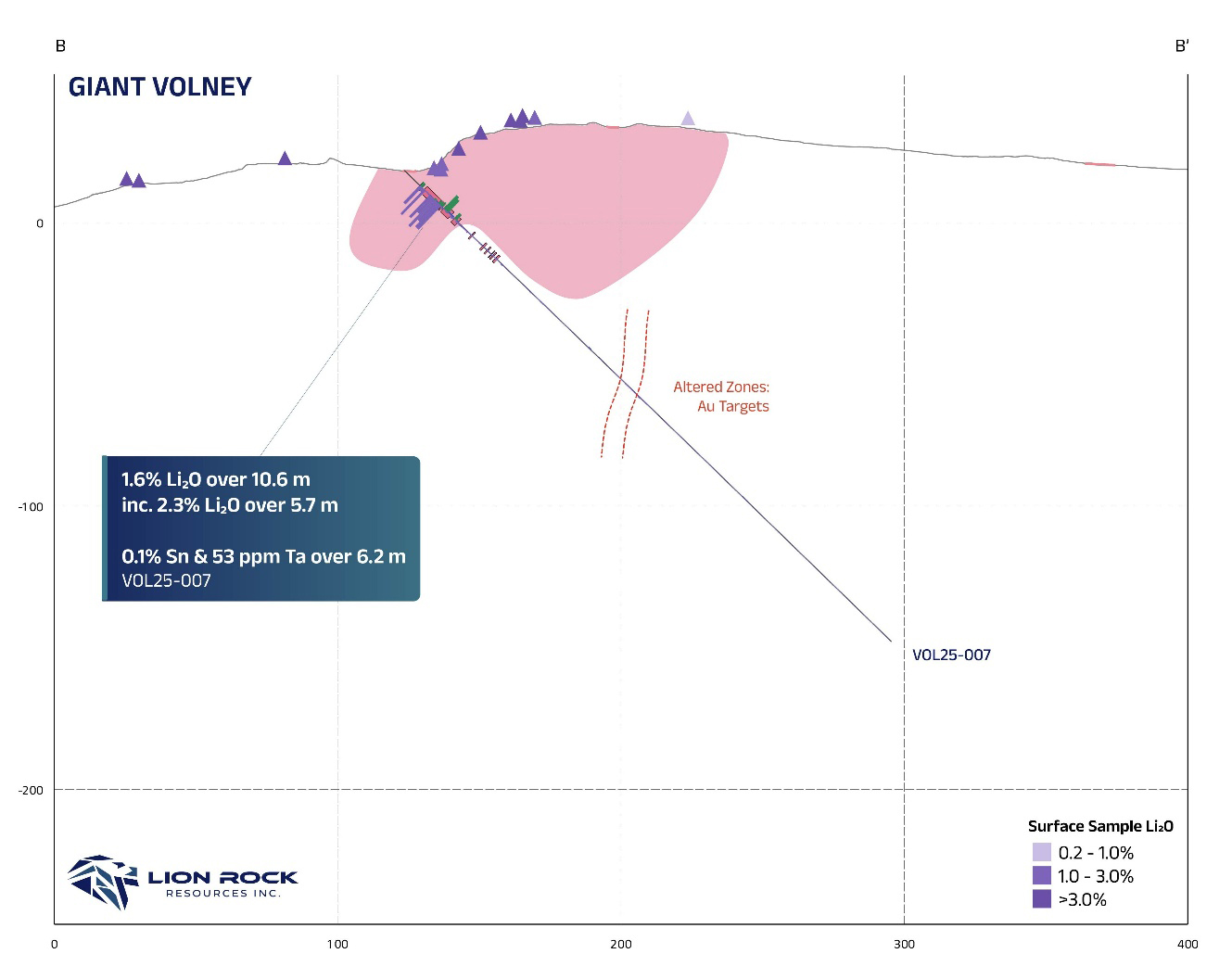
Figure 3. Cross-section looking northwest showing pegmatite intersections and notable lithium, tin, and tantalum intercepts from drillhole VOL25-007.
Table 1. Summary of notable lithium–tin–tantalum from Phase 1 drilling at the Giant Volney target area.
| Hole ID |
From (m) |
To (m) |
Length (m) |
Li2O% |
Sn% |
Ta ppm |
| VOL24-004 |
12.2 |
37.6 |
25.4 |
0.8 |
|
|
| including |
12.2 |
26.5 |
14.3 |
1.3 |
|
|
| & including |
20.4 |
26 |
5.7 |
|
|
72 |
| VOL24-005 |
8.7 |
19 |
10.3 |
1.5 |
|
|
| including |
15.5 |
16.8 |
1.3 |
2.2 |
|
|
| & including |
12.5 |
15.5 |
3.0 |
|
|
120 |
| VOL24-006 |
22.2 |
50.5 |
28.3 |
|
0.1 |
45 |
| including |
41.1 |
44.1 |
3.0 |
|
0.3 |
120 |
| VOL24-007 |
7.6 |
18.2 |
10.6 |
1.6 |
|
|
| including |
12.5 |
18.2 |
5.7 |
2.3 |
|
|
| |
19.3 |
25.5 |
6.2 |
|
0.1 |
53 |
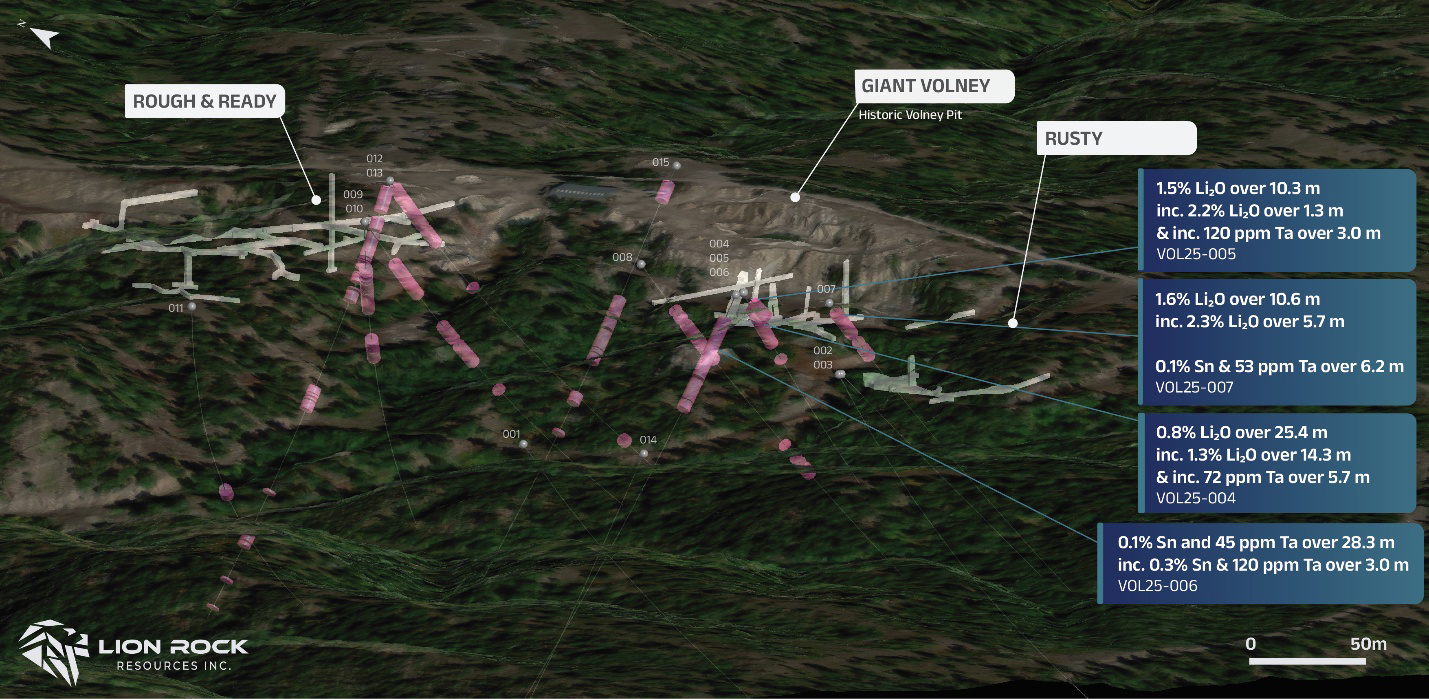
Figure 4. 3D perspective view of the Phase 1 drill program at the Volney Project showing pegmatite units intersected in drilling, drill traces, and lithium–tin–tantalum intercepts from drillholes VOL25-004, VOL25-005, VOL25-006, and VOL25-007.
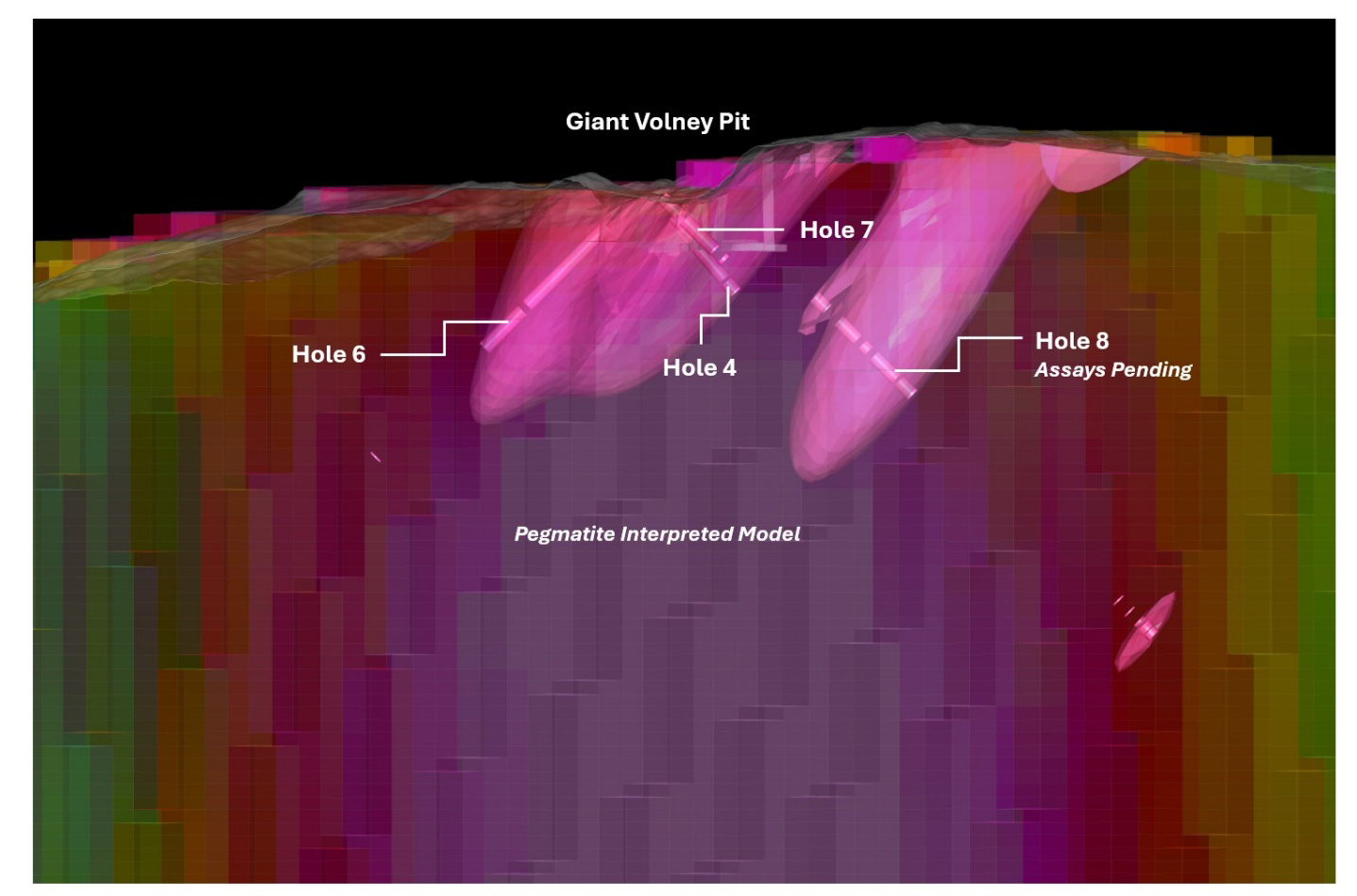
Figure 5. 3D perspective view of the Phase 1 drill program at the Volney Project showing logged pegmatite, modeled pegmatite, and magnetic inversion.
Quality Assurance / Quality Control (QA/QC)
The QA/QC protocol on the Volney property has been designed to follow industry best practices. Certified reference material and blank material were inserted at a rate of approximately 4% each. In addition, pulp and coarse duplicates were collected for approximately 10% of samples to assess consistency in mineralization and laboratory analysis.
All drill core samples were submitted to SGS Laboratories in Denver, Colorado, an independent and SO/IEC 17025-accredited facility, for sample preparation. Samples were dried at 105°C, crushed to 75% passing 2mm, riffle split into a representative sample and a 500g course reject, then pulverized to 85% passing 75 microns. Samples prospective for Lithium mineralization were submitted for 57-element sodium peroxide fusion ICP-AES/ICP-MS analysis (GE_ICM91A50). Gold prospective samples were analysed using 30 g fire assay with atomic absorption spectrometry finish (GE_FAA30V5) and 0.25g 33-element analysis by four-acid digest with an atomic emission spectroscopy finish (GE_ICP40Q12). Analysis was conducted at SGS Canada’s Burnaby facility.
About the Volney Project
The Volney property is a multi-commodity project strategically located in South Dakota’s Black Hills, a historically rich and active mining region (Figure 2). The Homestake Mine in the Black Hills produced more than 40 million ounces of gold, making it one of the most significant gold producers in North American history.1 The Volney Project is home to the Giant Volney pegmatite, a 635 m long LCT (Lithium-Cesium-Tantalum) pegmatite which remains untested at depth. The district continues to attract modern exploration efforts, with companies such as Dakota Gold Corp. actively advancing projects within the Black Hills. The project is accessible year-round and consists of private claims with surface and mineral rights, which facilitates rapid permitting and project advancement.
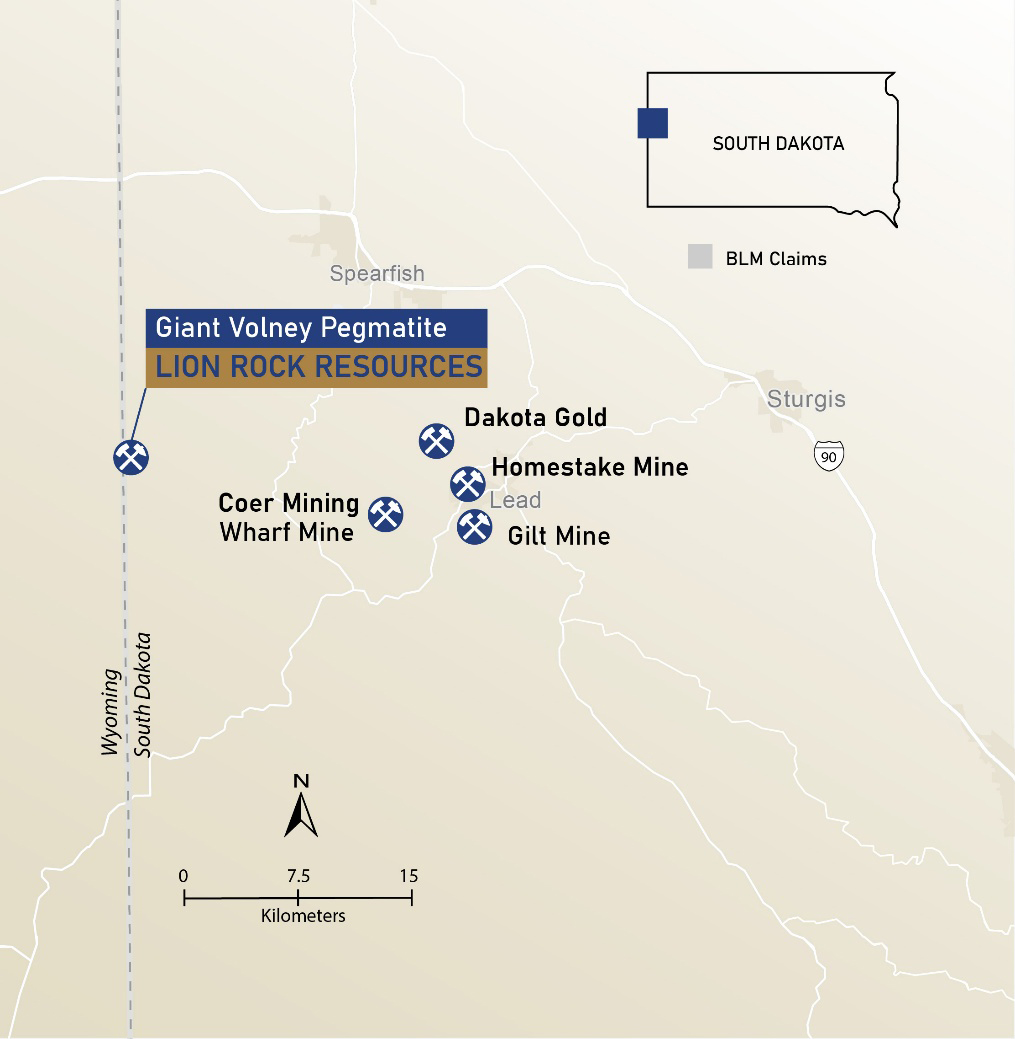
Figure 6. Volney Project regional map in the Black Hills, South Dakota.
The technical content of this news release has been reviewed and approved by Carl Ginn, P.Geo., consultant to the Company and a Qualified Person pursuant to National Instrument 43-101.
About Lion Rock Resources Inc.
Lion Rock Resources Inc. is a Canadian mineral exploration company committed to advancing high-grade gold and lithium projects across North America. The Company’s flagship asset, the Volney Project, is located in South Dakota’s Black Hills, a mining-friendly jurisdiction surrounded by active gold operations. The Company is led by an award-winning team with a proven track record of mineral discoveries, project development, and financing.
On Behalf of the Board
R. Dale Ginn, President & Chief Executive Officer
O: 604-678-5308
E: [email protected]
Neither the TSX Venture Exchange nor its Regulation Services Provider (as that term is defined in the policies of the TSXV Venture Exchange) accepts responsibility for the adequacy or accuracy of this release.
Caution Regarding Forward-Looking Information
Certain statements contained in this news release may constitute “forward-looking information” within the meaning of Canadian securities legislation. Forward-looking information is often, but not always, identified by the use of words such as “anticipate”, “plan”, “estimate”, “expect”, “may”, “will”, “intend”, “should”, “potential”, “indicative” and similar expressions. Forward-looking information involves known and unknown risks, uncertainties and other factors that may cause actual results or events to differ materially from those anticipated in such forward-looking information. Such forward-looking information is based on the current expectations of management of the Company. The Company’s actual results could differ materially from those anticipated in this forward-looking information as a result of risks and uncertainties, including without limitation risks and uncertainties inherent in the exploration and development of mineral properties, fluctuations in commodity prices, counterparty risk, market conditions, regulatory decisions, competitive factors in the industries in which the Company operates, prevailing economic conditions, changes to the Company’s strategic growth plans, and other factors, many of which are beyond the control of the Company. The Company believes that the expectations reflected in the forward-looking information are reasonable, but no assurance can be given that these expectations will prove to be correct and such forward-looking information should not be unduly relied upon. In making the forward-looking statements in this press release, the Company has applied several material assumptions. Any forward-looking information contained in this news release represents the Company’s expectations as of the date hereof and is subject to change after such date. The Company disclaims any intention or obligation to update or revise any forward-looking information whether as a result of new information, future events or otherwise, except as required by applicable securities legislation.
1 James Norton, 1974, Gold in the Black Hills, South Dakota, and how new deposits might be found, USGS Publications Warehouse