
| Drillhole | From (m) | To (m) | Length (m) | Au (g/t) | Notes |
|---|---|---|---|---|---|
| VOL25-002 | 12.5 | 48.9 | 36.5 | 0.5 | Incl. 4.6 m at 2.1 g/t Au |
| VOL25-006 | 261.6 | 286.4 | 24.8 | 0.8 | Incl. 10.9 m at 2.0 g/t Au; stacked interval above 19.3 m at 0.4 g/t Au |
| VOL25-009 | 129.0 | 151.5 | 22.5 | 0.9 | Incl. 11.2 m at 1.1 g/t Au; stacked zones at depth |
| VOL25-013 | 57.8 | 81.0 | 23.2 | 1.1 | Highest metal factor intercept in program |
| VOL25-014 | 25.97 | 28.03 | 2.1 | 5.0 | Incl. 1.1 m at 8.12 g/t Au |
A New Gold Discovery
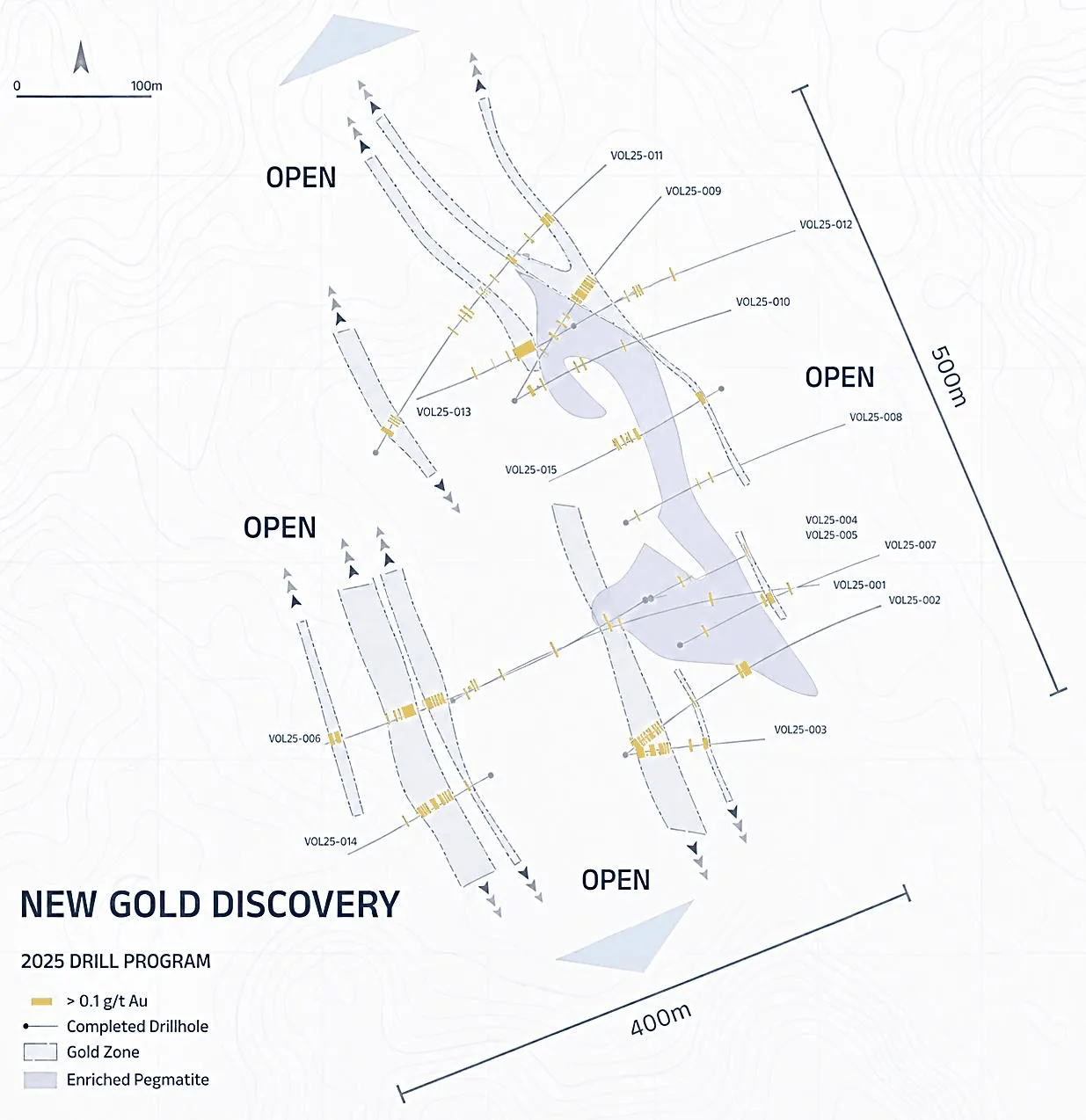
Phase 1 drilling at Volney returned gold in all nine drillholes that targeted gold-bearing structures — a 100% hit rate — defining a zone 500 m along strike, 400 m wide, and 200 m deep in South Dakota's Tinton District.
9 of 9 Gold Holes Mineralized 500 × 400 × 200 m Zone Open in Every Direction Announced April 2026
The Numbers
First Modern Drilling, First Discovery
The 2025–2026 Phase 1 program was the first modern drill testing of the Volney trend — and every hole aimed at a gold-bearing structure hit.
0%
Hit rate — nine of nine gold-targeting holes
0m
Strike length — confirmed and growing
0m
Width of the mineralized zone
0m
Vertical depth — open below
Reported intervals are downhole lengths. True widths are unknown. Grades are uncut.
New Gold Discovery · April 2026
Stacked Zones, Open in Every Direction
Multiple distinct gold zones within a shear-hosted trend extending ~1.6 km inside a broader 3.5 km structural corridor — in the region that produced Homestake's 40M+ oz, with gold above US$5,500/oz in Q1 2026.
500 m
Strike
400 m
Width
200 m
Depth
- 23.2 m @ 1.1 g/t Au highest metal factor in programVOL25-013
- 10.9 m @ 2.0 g/t Au within 24.8 m @ 0.8 g/tVOL25-006
- 2.1 m @ 5.0 g/t Au incl. 1.1 m @ 8.12 g/tVOL25-014
- 22.5 m @ 0.9 g/t Au incl. 11.2 m @ 1.1 g/tVOL25-009
- 4.6 m @ 2.1 g/t Au within 36.5 m @ 0.5 g/tVOL25-002
Stacked zones: VOL25-006 and VOL25-009 intersected multiple intervals at different depths within the same hole — continuity favourable for resource development.
Phase 1 Results
Notable Gold Intercepts
Four intercepts returned metal factors above 18 gram-metres, and multiple drillholes returned stacked gold zones at different depths — pointing to structural complexity within the system.
Reported intervals are downhole lengths. True widths are unknown. Grades are uncut. Metal factor is calculated as Au (g/t) × length (m). Several holes have been sent for screen metallic fire assay analysis to account for coarse gold observed in logging, which may produce revised gold grades on follow-up reporting. Drill intercepts are individual results and are not directly comparable to resource estimate averages.
Gold Before the Drill Rig
A Shear-Hosted System in a Past-Producing District
Gold at Volney is hosted in sulphide-bearing shear zones within altered mafic volcanics and metasedimentary rocks — a geologically distinct system from the LCT pegmatite that hosts the property's lithium, tin, and tantalum.
Volney is not a greenfield concept. The property includes the historic Rusty Mine and Rough and Ready Mine, documented Tinton District workings where gold was mined at commercial grades from shear-hosted structures. Historic channel sampling at the Rough and Ready Mine returned 18.2 g/t Au over 18.3 metres, confirming the persistence of high-grade gold at surface prior to Lion Rock's modern work.
The Rough and Ready Mine was also a significant tin producer — 105,039 lbs of tin between 1903 and 1927 — and both the Giant Volney and Rough and Ready mines are indexed as distinct localities in Mineralogy of the Black Hills (Roberts & Rapp, 1965), the authoritative reference on Black Hills ore deposits.
No modern systematic exploration was conducted at Volney until Lion Rock's acquisition in October 2024. The Phase 1 program is the first modern drill testing of the Volney trend — and its 100% hit rate across nine gold-targeting holes confirms the continuity and scale interpreted from surface mapping.
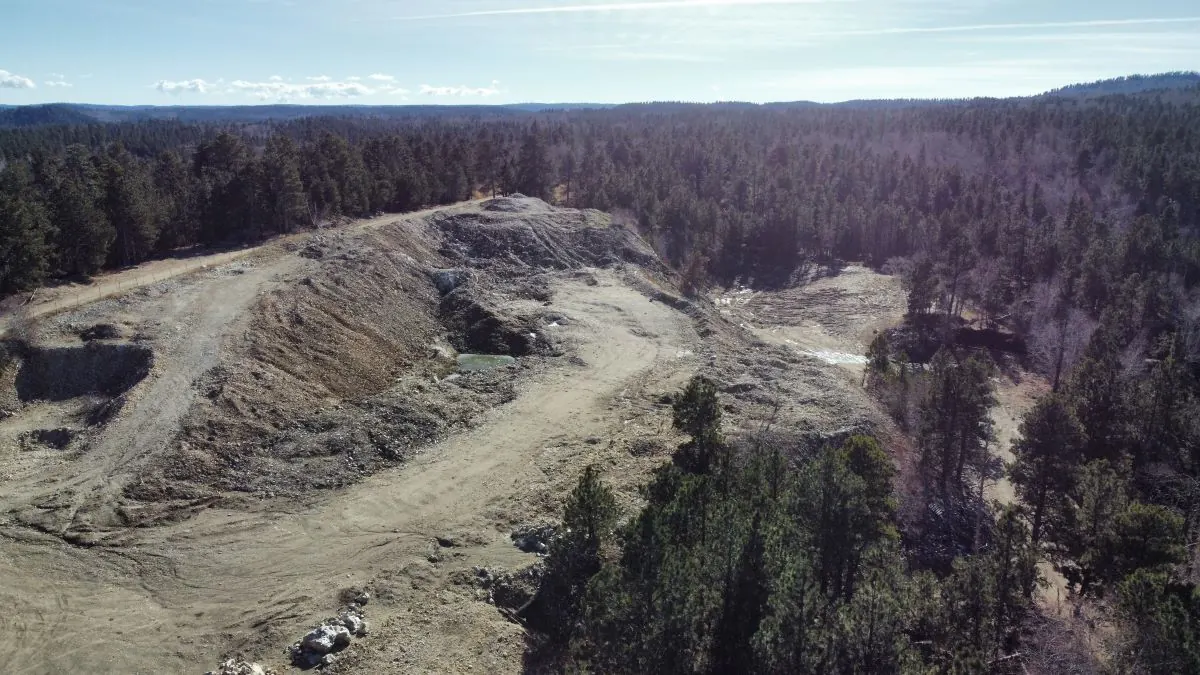
Historical results referenced above have not been verified by a Qualified Person and should not be relied upon. They are presented as an indication of the exploration history of the property.
The Tinton District
Why This Discovery Matters
01
An Overlooked District
The Tinton District is a pegmatite-dominated district in the northwestern Black Hills — geologically distinct from the Homestake District to the east. Its mix of shear-hosted gold and LCT pegmatites didn't fit gold-only exploration models, leaving it largely untested by modern drilling.
02
Private Land, Fast Execution
Volney's 142 hectares of private claims carry surface and mineral rights outright. Lion Rock moved from acquisition to sampling, mapping, geophysics, and a completed 15-hole, ~3,600 m drill program in just over twelve months — a pace that is difficult to replicate on federal ground.
03
Gold Above US$5,500/oz
Spot gold exceeded US$5,500/oz in Q1 2026. In a proven mining state ranked among the most mining-friendly jurisdictions globally, gold at Volney offers revenue diversification alongside the critical minerals story.
04
Multi-Commodity Ground
The same property hosts a confirmed LCT pegmatite system with lithium, tin, and tantalum mineralization — multiple independent exploration targets within a single 142 ha footprint.
05
Room to Grow
Phase 1 targeted one high-priority area. Additional gold targets across the broader claim block remain untested by drilling, and the discovery zone itself remains open in every direction.
06
Results Still Coming
Several holes are undergoing screen metallic fire assay analysis to account for coarse gold observed in logging — additional analytical work that may produce revised gold grades on follow-up reporting.
Common Questions
Gold at Volney — FAQ
Has gold been confirmed at the Volney Project?
Yes. Phase 1 drilling returned gold mineralization in all nine drillholes that targeted gold-bearing structures, defining a mineralized zone 500 m along strike, 400 m wide, and 200 m in depth that remains open in every direction. Highlights include 23.2 m at 1.1 g/t Au (VOL25-013), 24.8 m at 0.8 g/t Au including 10.9 m at 2.0 g/t (VOL25-006), and 2.1 m at 5.0 g/t Au including 1.1 m at 8.12 g/t (VOL25-014).
What is the Tinton District?
A historic pegmatite-dominated mining district in the northwestern Black Hills of Lawrence County, South Dakota — a documented past producer of tin, gold, lithium, and tantalum, with production concentrated between the 1870s and the 1950s. It is geologically distinct from the better-known Homestake District to the east. Volney sits at the heart of the Tinton District and includes the historic Giant Volney and Rough and Ready mines.
What is the host rock for gold at Volney?
Gold is hosted in sulphide-bearing shear zones within altered mafic volcanic rocks and metasedimentary units — geologically distinct from the LCT pegmatite that hosts Volney's lithium, tin, and tantalum. Both styles of mineralization coexist within the Tinton District's structural framework.
Are the Phase 1 gold results final?
Not yet. Several drillholes have been flagged for screen metallic fire assay analysis due to observed coarse gold. This additional analytical work may result in revised gold grades when final results are reported.
What other commodities are present at Volney?
The property hosts confirmed lithium, tin, and tantalum within a separate LCT pegmatite system, with additional US Critical Minerals identified through Phase 1 analytical work. See the dedicated lithium, tin, and tantalum pages, or the Volney Project overview.
Current Status · July 2026
Phase 1 is complete, with all assay results received. Metallurgical test work is underway on Phase 1 drill core and bulk samples, and planning for an expanded Phase 2 drill program — aggressive step-out drilling plus discovery drilling on new high-priority targets — is underway, targeting Q3/Q4 2026. The project has on-site power, all-season road access, and is within an hour of the US rail network.
See the Phase 1 initial results (February 26, 2026) and final results (May 5, 2026).
Sources & Disclosures
References
- Lion Rock Resources Inc. (2026), “Lion Rock Makes New Gold Discovery at Volney, South Dakota,” news release, April 8, 2026
- Roberts, W.L. and Rapp, G. Jr. (1965), Mineralogy of the Black Hills. South Dakota School of Mines and Technology Bulletin 18 — reference publication for Tinton Pegmatite District localities including the Giant Volney and Rough and Ready mines.
- Smith, W.C. and Page, L.R. (1941), “Tin-Bearing Pegmatites of the Tinton District, Lawrence County, South Dakota.” US Geological Survey; cited in US Bureau of Mines Information Circular 7688 (1954), Black Hills Mineral Atlas, South Dakota, Part I.
- Nellis, J.M. (1973), Geology of the Tinton District, Lawrence County, South Dakota — historic Rough and Ready Mine production records.
- Page, L.R. et al. (1953), “Pegmatite Investigations 1942–45, Black Hills, South Dakota.” USGS Professional Paper 247.
Qualified Person
The technical content of this page has been reviewed and approved by Carl Ginn, P.Geo., consultant to the Company and a Qualified Person pursuant to National Instrument 43-101.
Forward-Looking Information
Certain statements on this page constitute forward-looking information within the meaning of applicable Canadian securities laws, including statements regarding planned exploration programs, the potential characteristics of the Volney Project's mineralization, and anticipated timelines. Such statements are based on current expectations and assumptions and are subject to risks and uncertainties that could cause actual results to differ materially. The Company does not undertake to update forward-looking statements except as required by law.
Disclaimer
This page presents factual information about the Volney Project and the gold market and does not constitute investment advice, a recommendation to purchase securities, or an offer of securities for sale. Technical data is sourced from Company news releases and publicly available third-party sources. Historic production figures are derived from published geological reports and government surveys, have not been verified by a Qualified Person, and do not constitute current mineral resources or reserves. Reported drill intervals are downhole lengths; true widths are unknown; grades are uncut. References to other companies are factual and do not imply endorsement or equivalence.
Stay Connected
Follow the Volney Project
Get updates on exploration progress, drilling results, and company news from Lion Rock Resources.
Investor Updates
Subscribe for Updates
News releases, drill results, and project milestones delivered straight to your inbox. Be the first to know.
By subscribing you consent to receive news, updates, and other communications by commercial electronic message from Lion Rock Resources Inc. You may withdraw consent at any time via the unsubscribe link in every email.
Speak with Investor Relations
Questions on the company, share structure, or the Volney Project? Reach our team directly.
Contact IRinfo@lionrockresources.com · +1 604 678 5308