
| Drillhole | Ta₂O₅ (ppm) | Length | From (m) | To (m) | Notes |
|---|---|---|---|---|---|
| VOL25-008 | 309 | 2.4 m | 65.7 | 68.1 | |
| VOL25-009 | 348 | 3.0 m | 73.0 | 76.0 | |
| VOL25-010 | 327 | 4.1 m | 34.9 | 39.0 | Near surface |
| VOL25-010 | 788 | 5.9 m | 112.1 | 118.0 | Incl. 1,605 ppm over 2.0 m |
| VOL25-012 | 294 | 5.5 m | 22.5 | 28.0 | Near surface; co-occurring with 0.2% Sn |
| VOL25-012 | 243 | 6.0 m | 43.0 | 49.0 | Co-occurring with 0.6% Li₂O |
| VOL25-012 | 260 | 0.5 m | 91.0 | 91.5 | Co-occurring with 1.0% Sn |
| VOL25-013 | 505 | 10.5 m | 24.9 | 35.4 | Incl. 848 ppm over 5.6 m; 3,715 ppm over 1.0 m |
| VOL25-013 | 263 | 1.6 m | 177.8 | 179.4 | Confirms mineralization at depth |
| VOL25-015 | 576 | 1.0 m | 82.5 | 83.5 |
Tantalum at Volney
The US is 100% import-reliant on tantalum and has not mined it domestically since 1959. Lion Rock is advancing one of the only active tantalum exploration and development projects in the country — with Phase 1 grades far above the commercial threshold.
3,715 ppm Ta₂O₅ Peak Threshold ≈ 150 ppm US 100% Import Reliant Historic Producer · 1941–44
Drill Confirmed
Grades Well Above the Commercial Threshold
Phase 1 returned high-grade tantalum in tantalite-bearing pegmatite from near surface at the Giant Volney and Rough and Ready targets — exceeding the ~150 ppm Ta₂O₅ threshold in nearly every hole that returned tantalum assays.
0ppm
Peak Ta₂O₅ over 1.0 m — VOL25-013
0ppm
Ta₂O₅ over 5.9 m — VOL25-010
~0ppm
Commercial threshold for tantalum
0
Last year tantalum was mined in the US
For context, the Round Top project in Texas carries a resource estimate averaging 67.2 ppm Ta₂O₅. Volney figures are individual drill intercepts and are not directly comparable to resource estimate averages.
Why Tantalum Is Strategic
Where Failure Means Mission Failure
Tantalum capacitors regulate electrical energy across radar, missile guidance, satellite communications, electronic warfare, and UAV flight systems — and the US Department of Defense is one of the world's largest institutional buyers.
$2.1B
Capacitor Market
The global tantalum capacitor market was valued at ~USD 2.1 billion in 2025, with the military segment alone at USD 268 million and steady projected growth through 2033. Tantalum is also used in semiconductor sputtering targets, medical implants, and data centers.
+75%
US Demand Surge
US consumption reached an estimated 770 tonnes in 2024, up 75% year-over-year, driven by semiconductor recovery and data-center expansion. The CHIPS and Science Act has directed nearly USD 34 billion toward domestic chip fabrication.
100%
Import Reliance
The US imports all of its tantalum. China accounts for 22% of US imports, and ~40% of global mine output comes from the DRC's conflict-affected artisanal operations — flagged as structural long-term supply risks.
The USGS estimates ~55,000 tonnes of tantalum in identified US deposits, historically considered subeconomic. Policy incentives — DOE Critical Minerals and Materials, EXIM Bank Project Vault, and DoD National Defense Stockpile initiatives — are now shifting the landscape for US tantalum exploration.
The Volney ProjectPhase 1 Results
Tantalum Intercepts
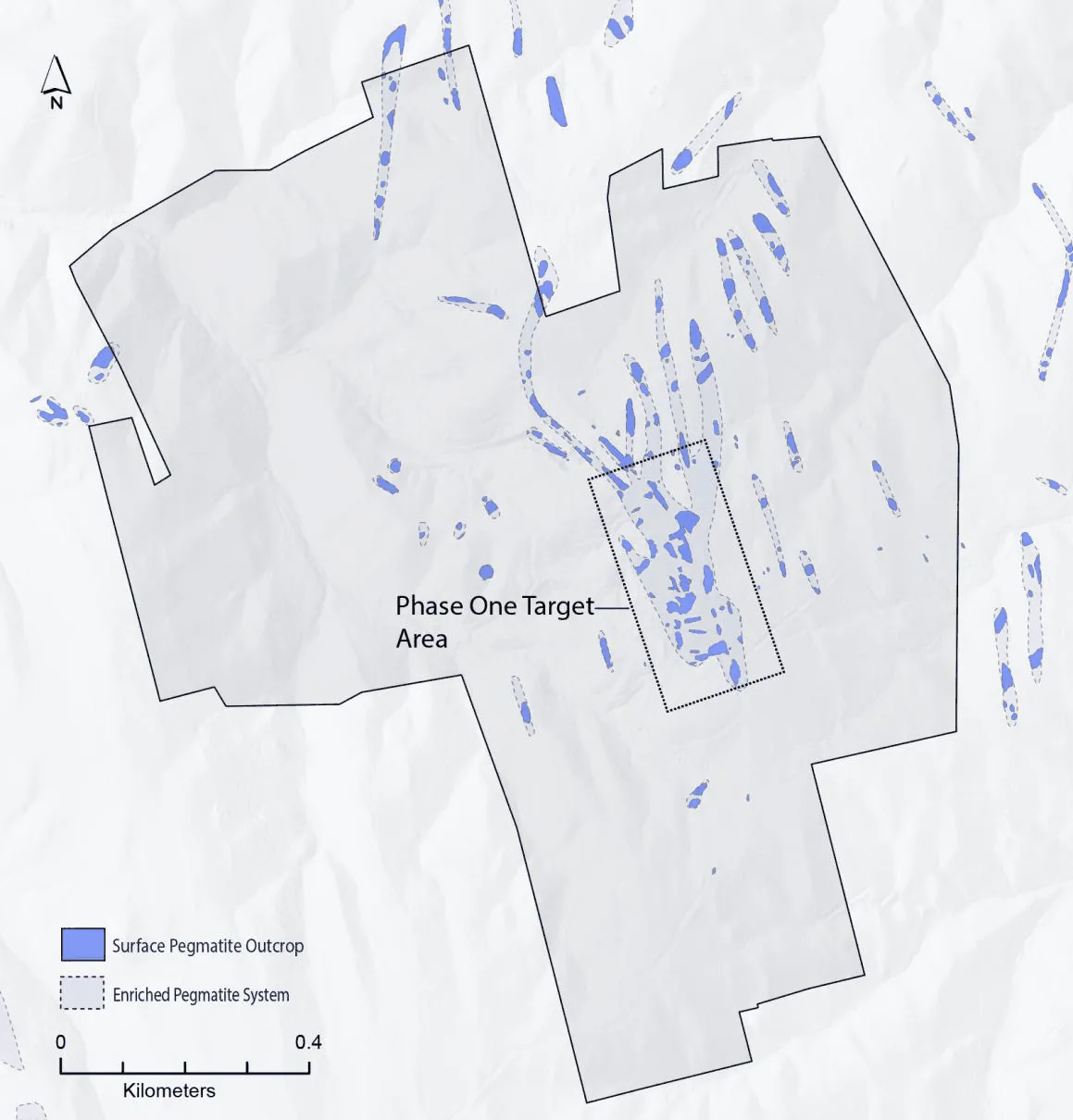
Tantalum co-occurs with lithium and tin within a single LCT pegmatite trend — a critical minerals strike measuring 300 m long, up to 100 m wide, and 150 m deep, open in every direction.
Reported intervals are downhole lengths. True widths are unknown. Reported grades are uncut and no capping has been applied. Only intervals with Ta₂O₅ values exceeding 200 ppm are shown; additional tantalum values were returned across the program. Phase 1 tested just one of multiple pegmatite targets at Volney.
Production History
A Wartime Tantalum Producer
Between 1941 and 1944, Fansteel Mining Corp. operated the Giant Volney pegmatite under lease and produced 21,884 lbs of tantalite concentrates at 45% Ta₂O₅ — alongside 1,080 tonnes of spodumene concentrate, 400 tonnes of amblygonite concentrate, and 3,800 lbs of cassiterite, as part of the US wartime strategic minerals program.
Earlier, a 1928–29 campaign at the Rough and Ready Mine produced 13.1 tonnes of tantalite concentrate grading 38.7% to 57% Ta₂O₅ along with cassiterite concentrate at 30.7% Sn.
All of this came from a single zone of the property. The bulk of Volney's 142 hectares saw little-to-no exploration until Lion Rock's 2025–26 work programs — the first drilling to test the pegmatite system with contemporary analytical methods.
Historic production figures are derived from published geological reports and government surveys, have not been verified by a Qualified Person, and do not constitute current mineral resources or reserves.
One Property
Six US Critical Minerals, Plus Gold
Phase 1 analytical work identified six minerals on the current US Critical Minerals List at Volney — with a new gold discovery on top.
LiLithiumBatteries · EVs SnTinSolder · Chips TaTantalumDefense · Capacitors GaGalliumRadar · 5G CsCesiumCritical Mineral RbRubidiumCritical Mineral
Common Questions
Tantalum at Volney — FAQ
Is Volney a producing tantalum mine?
No. The property has a documented history of tantalite concentrate production (1941–44), but there is no current mining operation and the project is at the exploration stage. Phase 1 confirmed high-grade tantalum mineralization, including 788 ppm Ta₂O₅ over 5.9 m (VOL25-010) and 505 ppm Ta₂O₅ over 10.5 m including 3,715 ppm over 1.0 m (VOL25-013).
Why is the US 100% import-reliant on tantalum?
The US has not mined tantalum since 1959. Domestic resources exist — the USGS estimates roughly 55,000 tonnes in identified deposits — but have historically been considered subeconomic. Policy incentives around domestic critical mineral supply chains are now shifting the landscape for US tantalum exploration.
What distinguishes Volney from most other US critical mineral projects?
Four factors: private land ownership with surface and mineral rights, excellent access to infrastructure, a documented tantalum production history confirming mineralization at surface, and a confirmed multi-mineral signature — lithium, tin, and tantalum within a single pegmatite system in a Tier 1 US jurisdiction, with grades well above the ~150 ppm Ta₂O₅ commercial threshold.
How many critical minerals are present at Volney?
Six: lithium, tin, tantalum, gallium, cesium, and rubidium — all on the current US Critical Minerals List. Gold has also been confirmed.
Where can I review the full drill results?
Phase 1 initial results were published on February 26, 2026, and final Phase 1 results on May 5, 2026. Both are available on the news page and filed on SEDAR+.
Current Status · July 2026
Phase 1 is complete, with all assay results received. Metallurgical test work is underway on Phase 1 drill core and bulk samples, and planning for an expanded Phase 2 drill program — aggressive step-out drilling plus discovery drilling on new high-priority targets — is underway, targeting Q3/Q4 2026. The project has on-site power, all-season road access, and is within an hour of the US rail network.
See the Phase 1 initial results (February 26, 2026) and final results (May 5, 2026).
Sources & Disclosures
References
- Lion Rock Resources Inc. (2026), “Lion Rock Expands Critical Minerals Strike; Continues 100% Drill Hit Rate at Volney, South Dakota,” news release, May 5, 2026
- U.S. Geological Survey, Mineral Commodity Summaries: Tantalum, January 2025
- Silverado Policy Accelerator (2025), “Tantalum: The Global Supply Chain.”
- Intel Market Research, “Global Tantalum Capacitors Market Outlook 2025–2032.”
- Data Insights Market, “Military Tantalum Capacitors Market Trends and Forecast 2025–2033.”
- Page, L.R. et al. (1953), “Pegmatite Investigations 1942–45, Black Hills, South Dakota.” USGS Professional Paper 247 — Fansteel Mining Corp. historic production at Giant Volney.
- Redfern, R.M. (1992), Mineral Resources of the Black Hills Area, South Dakota — 1928–29 tantalite concentrate campaign.
- Nellis, J.M. (1973), Geology of the Tinton District, Lawrence County, South Dakota.
Qualified Person
The technical content of this page has been reviewed and approved by Carl Ginn, P.Geo., consultant to the Company and a Qualified Person pursuant to National Instrument 43-101.
Forward-Looking Information
Certain statements on this page constitute forward-looking information within the meaning of applicable Canadian securities laws, including statements regarding planned exploration programs, the potential characteristics of the Volney Project's mineralization, and anticipated timelines. Such statements are based on current expectations and assumptions and are subject to risks and uncertainties that could cause actual results to differ materially. The Company does not undertake to update forward-looking statements except as required by law.
Disclaimer
This page presents factual information about the Volney Project and the tantalum market and does not constitute investment advice, a recommendation to purchase securities, or an offer of securities for sale. Technical data is sourced from Company news releases and publicly available third-party sources. Historic production figures are derived from published geological reports and government surveys, have not been verified by a Qualified Person, and do not constitute current mineral resources or reserves. Reported drill intervals are downhole lengths; true widths are unknown; grades are uncut. References to other companies are factual and do not imply endorsement or equivalence.
Stay Connected
Follow the Volney Project
Get updates on exploration progress, drilling results, and company news from Lion Rock Resources.
Investor Updates
Subscribe for Updates
News releases, drill results, and project milestones delivered straight to your inbox. Be the first to know.
By subscribing you consent to receive news, updates, and other communications by commercial electronic message from Lion Rock Resources Inc. You may withdraw consent at any time via the unsubscribe link in every email.
Speak with Investor Relations
Questions on the company, share structure, or the Volney Project? Reach our team directly.
Contact IRinfo@lionrockresources.com · +1 604 678 5308