
| Drillhole | Li₂O (%) | Length | From (m) | Notes |
|---|---|---|---|---|
| VOL24-004 | 0.8 | 25.4 m | 12.2 | Incl. 1.3% Li₂O over 14.3 m |
| VOL24-005 | 1.5 | 10.3 m | 8.7 | Incl. 2.2% Li₂O over 1.3 m; 1.6% Li₂O over 3.0 m |
| VOL24-007 | 1.6 | 10.6 m | 7.6 | Incl. 2.3% Li₂O over 5.7 m — highest grade of the program; near surface |
| VOL25-009 | 0.3 | 4.7 m | 106.5 | Co-occurring with 0.1% Sn; Rough and Ready zone |
| VOL25-010 | 0.6 | 4.3 m | 99.1 | Incl. 0.9% Li₂O over 2.0 m; Rough and Ready zone |
| VOL25-012 | 0.3 | 6.5 m | 29.0 | Rough and Ready zone |
| VOL25-012 | 0.6 | 6.0 m | 43.0 | Incl. 1.5% Li₂O over 1.0 m; Rough and Ready zone |
| VOL25-013 | 0.2 | 10.5 m | 24.9 | Incl. 0.3% Li₂O over 5.6 m; near surface |
| VOL25-013 | 0.6 | 1.6 m | 177.8 | Confirms mineralization at depth |
Lithium at Volney
High-grade lithium in spodumene-bearing LCT pegmatite, from surface — drilled at a past-producing property in the Black Hills, one of the most prolific historic lithium pegmatite districts in the United States.
2.3% Li₂O over 5.7 m 0 m Depth to Mineralization Open in Every Direction Past Producer · 1941–44
The Lithium System
A Critical Minerals Strike, Starting at Surface
The completed 15-hole Phase 1 drill program returned high-grade lithium intercepts across multiple drillholes, establishing a critical minerals strike measuring 300 m long, up to 100 m wide, and 150 m deep. Mineralization starts at surface and the strike remains open in every direction.
Lithium is hosted within spodumene-bearing LCT (Lithium-Cesium-Tantalum) pegmatites — the primary global source of hard-rock lithium. Assays also returned tin and tantalum within the same drillholes, consistent with a fractionated, evolved LCT system.
These results came from the first of multiple high-priority pegmatite targets at Volney. Surface sampling has confirmed additional mineralized pegmatites along strike and across the broader 142-hectare property — all untested by drilling — and additional pegmatite units were intersected more than 250 metres north of the Giant Volney area.
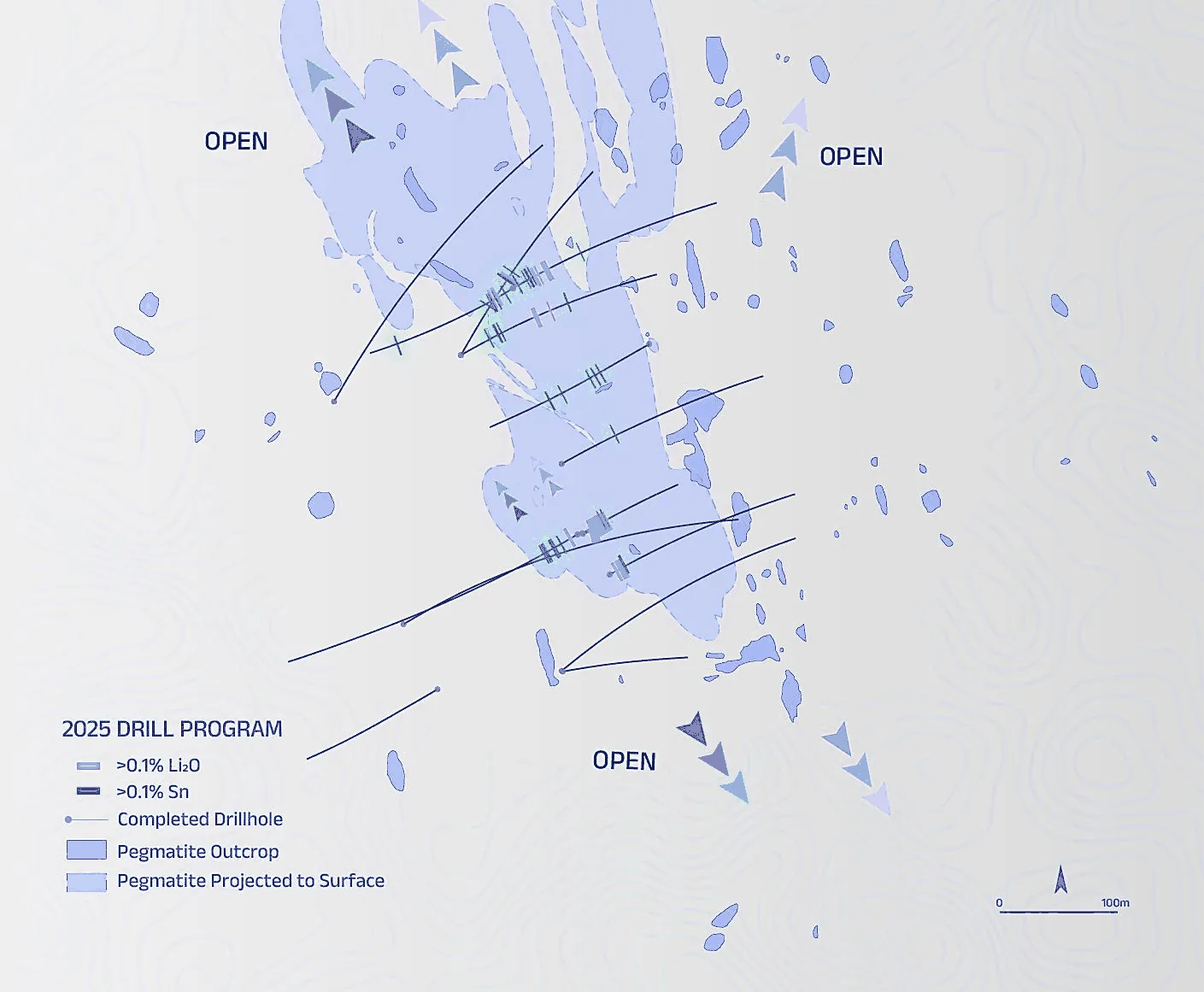
0% Li₂O
Over 5.7 m — VOL24-007
0m
At 0.8% Li₂O from 12.2 m — VOL24-004
0m
Strike — open in every direction
0m
Depth to mineralization — from surface
Phase 1 Results
Lithium Intercepts
Lithium-bearing pegmatite intersected from surface across multiple drillholes, with high-grade sub-intervals in both the Giant Volney and Rough and Ready zones.
Reported intervals are downhole lengths. True widths are unknown. Reported grades are uncut and no capping has been applied. The initial four drillholes were collared directly into the pegmatite body, so reported intervals represent partial intersections only — the full interpreted width of the pegmatite extends west of the drill collars based on surface mapping and sampling. Drill intercepts are individual results and are not directly comparable to resource estimate averages.
Grade Context
How Volney's Lithium Grades Stack Up
Individual Phase 1 intercepts sit at or above the ~0.8–1.0% Li₂O commercial threshold for hard-rock lithium — among the highest reported for a US domestic critical minerals project.
Volney — VOL24-007Drill intercept · 5.7 m 2.3% Li₂O
Li-FT Power — Yellowknife LithiumDrill intercept · 17 m 1.65% Li₂O
Piedmont Lithium — CarolinaResource estimate average · 44.2 Mt 1.08% Li₂O
Volney — VOL24-004Drill intercept · 25.4 m 0.8% Li₂O
Commercial threshold ≈ 0.8–1.0% Li₂O
Comparison shown for context only. Volney figures are individual drill intercepts; they are not resource estimates and are not directly comparable to resource estimate averages such as Piedmont's. References to other companies are factual and do not imply endorsement or equivalence.
Production History
A Past Producer in America's Historic Lithium District
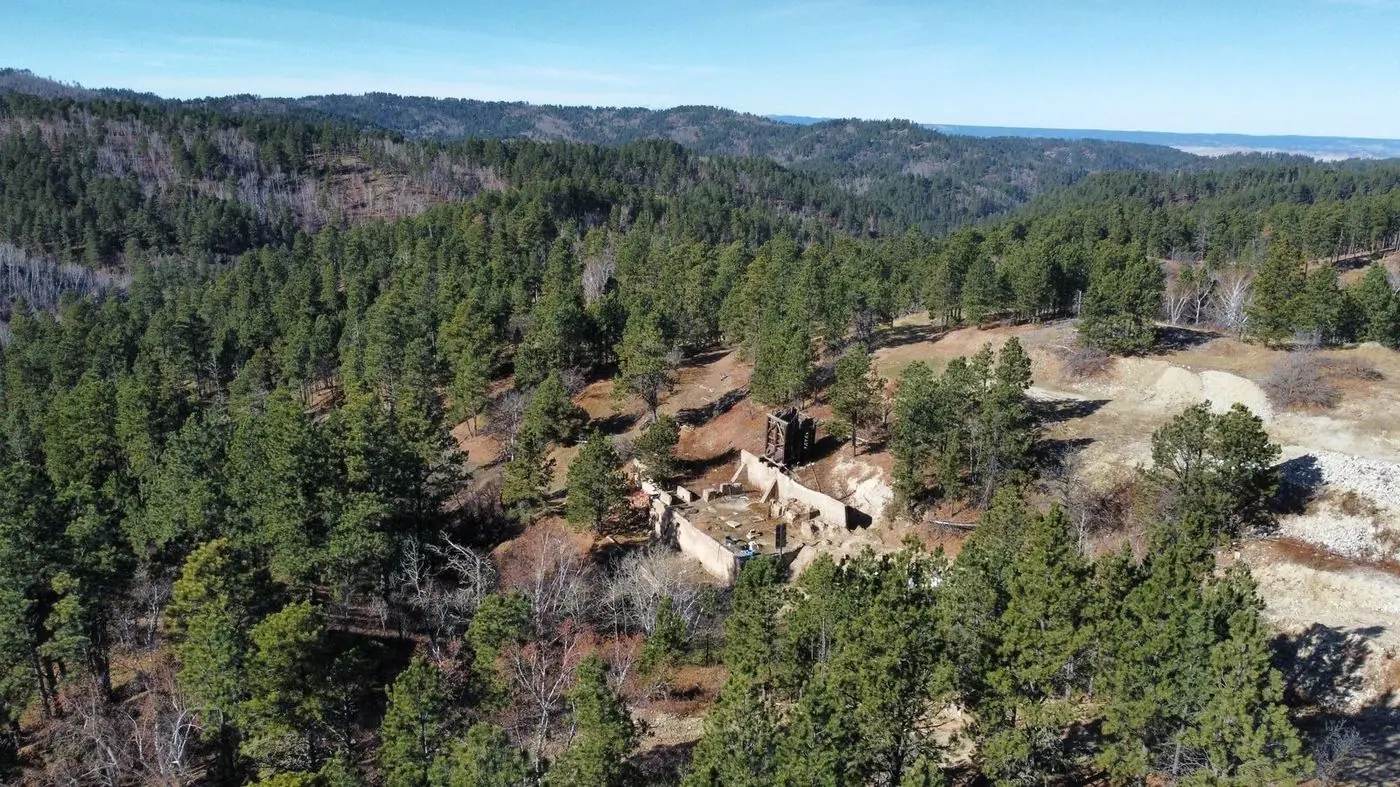
Between 1941 and 1944, Fansteel Mining Corp. operated the Giant Volney pegmatite under lease and produced 1,080 tonnes of spodumene concentrate grading 5.6% to 6.3% Li₂O, plus 400 tonnes of amblygonite concentrate at 8.3% Li₂O — historically one of the highest-grade lithium ores mined in the United States.
The surrounding Black Hills pegmatite province — more than 24,000 mapped pegmatite bodies — produced roughly 200,000 tonnes of lithium in the 1940s and 1950s — peaking at 8,600 short tons of spodumene concentrate in 1951 — including the famous Etta Mine, once the principal lithium producer in the US and source of spodumene crystals up to 42 feet long.
Yet the 635-metre-long Giant Volney pegmatite remained untested at depth until Lion Rock's Phase 1 program — the first drilling to test the system with contemporary analytical methods.
Historic production figures are derived from published geological reports and government surveys, have not been verified by a Qualified Person, and do not constitute current mineral resources or reserves.
Why It Matters
America's Lithium Gap
Lithium sits on the 2022 and 2025 US Critical Minerals Lists — foundational to EV batteries, grid storage, and defense applications, yet barely mined at home.
~97%
Imported from Two Countries
From 2020 to 2023 the US imported roughly 50% of its lithium from Chile and 47% from Argentina. China controls an estimated 60–70% of global lithium refining capacity.
1
Producing US Operation
Domestic output is limited to a single brine operation in Nevada. No active US mine produces lithium from hard-rock spodumene pegmatite — the source of most global battery-grade lithium.
$3B+
Federal Tailwinds
The DOE has directed USD 3 billion across 25 projects toward domestic lithium extraction, processing, and batteries, and the 2026 "Project Vault" stockpile initiative targets lithium and related critical minerals.
World lithium production rose 31% in 2025 and consumption rose 20% — long-term demand remains anchored to EVs and grid-scale storage. Spodumene is the preferred source of high-purity, battery-grade lithium.
The Volney ProjectCommon Questions
Lithium at Volney — FAQ
Has lithium been confirmed at the Volney Project?
Yes. Phase 1 returned multiple lithium intercepts in pegmatite from surface across the Giant Volney and Rough and Ready zones, including 2.3% Li₂O over 5.7 m (VOL24-007), 1.5% Li₂O over 10.3 m (VOL24-005), and 0.8% Li₂O over 25.4 m (VOL24-004), with mineralization confirmed at depth in the Rough and Ready zone. The property also produced spodumene and amblygonite concentrates between 1941 and 1944.
What is lithium used for?
Lithium is a foundational input to lithium-ion batteries used in electric vehicles, portable electronics, and grid-scale energy storage — the battery segment accounts for the majority of global demand. Lithium compounds are also used in specialty glass and ceramics, industrial lubricants, and pharmaceuticals.
Why is spodumene preferred for battery-grade lithium?
Spodumene-derived lithium produces fewer impurities than lithium extracted from continental brines, making it the preferred source for high-purity battery applications. Most current hard-rock lithium production comes from pegmatite-hosted spodumene deposits in Australia, with smaller operations in Canada, Brazil, and Zimbabwe.
What other lithium activity is there in the Black Hills?
The Black Hills hosts more than 24,000 mapped pegmatite bodies and historic producers including the Etta Mine, Tin Mountain Mine, Beecher Lode, Bob Ingersoll Mine, Peerless Mine, Hugo Mine, and Helen Beryl Mine. Companies currently exploring the district include Iris Metals, Midwest Lithium, Patriot Lithium, and United Lithium Corp.
What other minerals are present at Volney?
The project hosts confirmed tin and tantalum mineralization within the same LCT pegmatite system, plus a new gold discovery spanning 500 m × 400 m × 200 m announced in April 2026 — open in all directions.
Where can I review the full drill results?
Phase 1 initial results were published on February 26, 2026, and final Phase 1 results on May 5, 2026. Both are available on the news page and filed on SEDAR+.
Current Status · July 2026
Phase 1 is complete, with all assay results received. Metallurgical test work is underway on Phase 1 drill core and bulk samples, and planning for an expanded Phase 2 drill program — aggressive step-out drilling plus discovery drilling on new high-priority targets — is underway, targeting Q3/Q4 2026. The project has on-site power, all-season road access, and is within an hour of the US rail network.
See the Phase 1 initial results (February 26, 2026) and final results (May 5, 2026).
Sources & Disclosures
References
- Lion Rock Resources Inc. (2026), “Lion Rock’s First Results From Maiden Drill Program Reveals Discovery of Multiple Critical Mineral Intercepts Within the Volney Pegmatite,” news release, February 26, 2026
- Lion Rock Resources Inc. (2026), “Lion Rock Expands Critical Minerals Strike; Continues 100% Drill Hit Rate at Volney, South Dakota,” news release, May 5, 2026
- U.S. Geological Survey, Mineral Commodity Summaries: Lithium, January 2025
- Page, L.R. et al. (1953), “Pegmatite Investigations 1942–45, Black Hills, South Dakota.” USGS Professional Paper 247 — Fansteel Mining Corp. historic production at Giant Volney.
- Roberts, W.L. and Rapp, G. Jr. (1965), Mineralogy of the Black Hills. South Dakota School of Mines and Technology Bulletin 18.
- Hess, F.L. (1916), “Tin, Tungsten, and Tantalum Deposits of South Dakota.” USGS Bulletin 610.
- Dakota Matrix Minerals, “Pegmatites of the Black Hills, South Dakota.”
- Mindat, “Etta Mine, Keystone, Pennington County, South Dakota, USA.”
- Federal Register (2025), “Final 2025 List of Critical Minerals.”
- U.S. Geological Survey, 2022 Final List of Critical Minerals.
- U.S. Geological Survey (2026), “Value of U.S. mineral production rose last year” — 2025 production/consumption growth and Project Vault.
- International Energy Agency (2021), “The Role of Critical Minerals in Clean Energy Transitions.”
Qualified Person
The technical content of this page has been reviewed and approved by Carl Ginn, P.Geo., consultant to the Company and a Qualified Person pursuant to National Instrument 43-101.
Forward-Looking Information
Certain statements on this page constitute forward-looking information within the meaning of applicable Canadian securities laws, including statements regarding planned exploration programs, the potential characteristics of the Volney Project's mineralization, and anticipated timelines. Such statements are based on current expectations and assumptions and are subject to risks and uncertainties that could cause actual results to differ materially. The Company does not undertake to update forward-looking statements except as required by law.
Disclaimer
This page presents factual information about the Volney Project and the lithium market and does not constitute investment advice, a recommendation to purchase securities, or an offer of securities for sale. Technical data is sourced from Company news releases and publicly available third-party sources. Historic production figures are derived from published geological reports and government surveys, have not been verified by a Qualified Person, and do not constitute current mineral resources or reserves. Reported drill intervals are downhole lengths; true widths are unknown; grades are uncut. References to other companies are factual and do not imply endorsement or equivalence.
Stay Connected
Follow the Volney Project
Get updates on exploration progress, drilling results, and company news from Lion Rock Resources.
Investor Updates
Subscribe for Updates
News releases, drill results, and project milestones delivered straight to your inbox. Be the first to know.
By subscribing you consent to receive news, updates, and other communications by commercial electronic message from Lion Rock Resources Inc. You may withdraw consent at any time via the unsubscribe link in every email.
Speak with Investor Relations
Questions on the company, share structure, or the Volney Project? Reach our team directly.
Contact IRinfo@lionrockresources.com · +1 604 678 5308